Leave Your Message

What Are the 7 Best Optical Fiber Patch Cords?

Choosing the right Optical Fiber Patch Cord is not a small detail. It can affect signal stability, installation time, and maintenance effort. A short cord behind a crowded switch may bend sharply. A connector touched by dust can also introduce avoidable loss. Small details matter.

Fiber-optics educator Jim Hayes, founder of The Fiber Optic Association, offers a practical reminder: “Clean, inspect, and clean again.” That advice captures an often-overlooked part of patch-cord performance: connector care. Still, a clean end face cannot compensate for the wrong fiber type, connector, or polish. The best choice depends on the equipment, link distance, environment, and required performance—not a product ranking alone.

This guide examines seven common patch-cord options, from single-mode and multimode cords to simplex, duplex, armored, and specialty designs. Each suits different conditions. A data-center link may need a compact duplex cord, while a harsher route may call for added protection. Check connector compatibility, cable diameter, bend limits, and test documentation before buying. Look closely at the actual installation, too. A specification sheet cannot reveal every awkward rack corner.

There is no universal winner. Some trade-offs are easy to miss. The comparisons ahead explain what each type does well, where it falls short, and which details deserve a second look before installation.
What Are the 7 Best Optical Fiber Patch Cords?

How Fiber Patch Cords Differ: Fiber Mode, Connector, and Jacket Design

Choosing a fiber patch cord begins with the fiber mode. Single-mode fiber has a narrow core and suits longer links, such as connections between buildings. Multimode fiber is common for shorter runs inside data centers. Match the cord to the equipment and installed cabling. A mode mismatch can cause unreliable performance. Check the labels, not just the cable color.

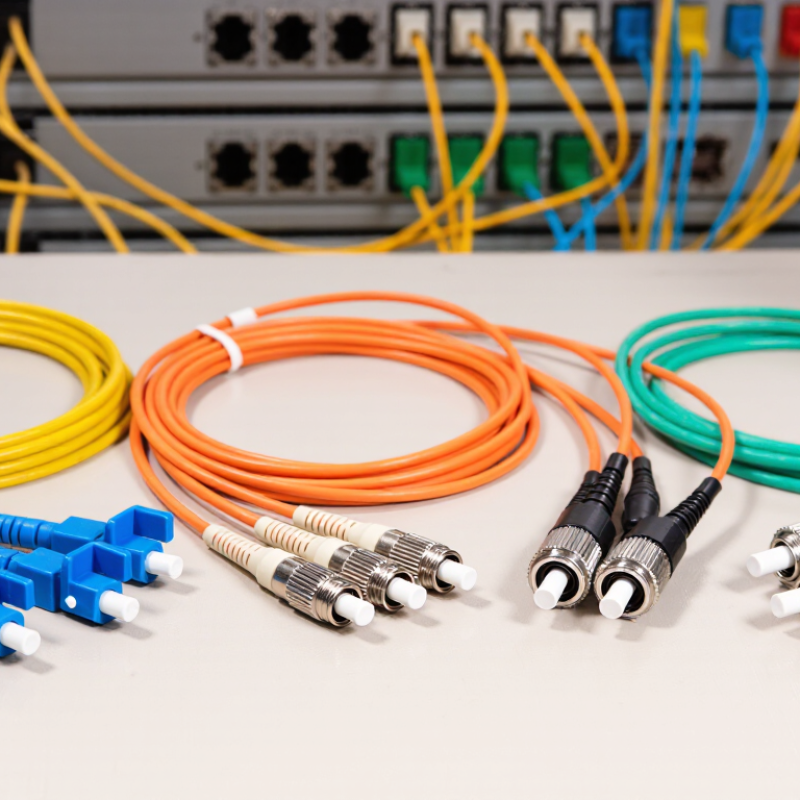
Connector choice affects fit and signal quality. LC connectors are compact and often fit densely packed panels; SC connectors use a larger push-pull body. The end-face polish matters, too: UPC and APC connectors should not be mated together. Inspect connector faces for dust before installation. It takes little time. A small particle can still disrupt a link.

Jacket design should suit the route. PVC jackets are common indoors, while LSZH options are chosen where reduced smoke and corrosive gas emissions are specified. Follow the site requirements; neither jacket is best for every setting. Respect the cable’s bend radius, especially behind crowded racks. Color can offer a clue, but conventions vary. I would not identify fiber mode from color alone. Check the marking and confirm the connector type before ordering replacement cords.

7 Common Optical Fiber Patch Cord Options

Typical maximum link distance for 10 Gb/s Ethernet using the corresponding fiber type and suitable optics.

Distances shown are typical maximums for 10GBASE-SR over multimode fiber and 10GBASE-LR over OS2 single-mode fiber. The vertical axis is logarithmic. Actual link reach depends on the transceivers and the complete installed cabling—not the patch cord alone. LC and SC connector formats do not change the fiber type’s rated reach.

The 7 Best Types: OS2, OM1, OM2, OM3, OM4, OM5, and Armored

OS2 is single-mode fiber for long campus links and carrier routes. Its small core carries light over kilometers with low signal loss. OM1 uses a 62.5-micrometer core; OM2, OM3, OM4, and OM5 use 50-micrometer cores. IEEE 802.3 Ethernet reach tables give 10GBASE-SR distances of 33 meters on OM1, 82 meters on OM2, 300 meters on OM3, and 400 meters on OM4. OM5 supports wideband multimode operation, including shortwave wavelength-division multiplexing. Check transceiver compatibility, not just the cable label.

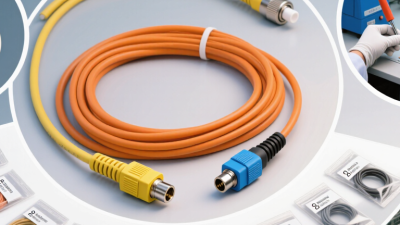
A practical distinction. Armored patch cords add a protective layer around the fiber, helping in exposed routes, equipment rooms, or areas where cords may be stepped on. Armor can also make a cord heavier and less flexible, so tight bends need attention. The Fiber Optic Association’s reference materials emphasize matching fiber type, connector, and application; in practice, connector polish and cleanliness matter too. A dusty end face can undermine an otherwise suitable link.

For a short rack connection, OM3 or OM4 may be enough, while OM5 is useful when compatible SWDM equipment is planned. OS2 suits longer single-mode links, but optics must match. OM1 and OM2 remain useful in existing installations, though their shorter high-speed reach can limit upgrades. One caveat: published reach values assume compliant components and installation. Real routes can be less forgiving.

What Are the 7 Best Optical Fiber Patch Cords? — The 7 Best Types: OS2, OM1, OM2, OM3, OM4, OM5, and Armored
Fiber type Fiber category and core/cladding Common operating wavelengths Typical 10 GbE reach Best suited for Important selection note
OS2 Single-mode; typically 9/125 µm Typically 1310 nm and 1550 nm Up to 10 km with 10GBASE-LR optics Campus links, data-center interconnects, and longer-distance connections Match the single-mode fiber and connector type to the transceiver and link design.
OM1 Multimode; 62.5/125 µm Typically 850 nm and 1300 nm Up to about 33 m with 10GBASE-SR Legacy multimode installations and short links Its 62.5 µm core differs from the 50 µm cores used by OM2–OM5; verify compatibility before mixing.
OM2 Multimode; 50/125 µm Typically 850 nm and 1300 nm Up to about 82 m with 10GBASE-SR Legacy building networks and short-reach links For new high-speed multimode links, OM3 or higher is generally a more suitable choice.
OM3 Laser-optimized multimode; 50/125 µm Typically 850 nm Up to 300 m with 10GBASE-SR Short-reach data-center and enterprise links A common choice for 10 GbE and supported short-reach higher-speed applications.
OM4 Laser-optimized, higher-bandwidth multimode; 50/125 µm Typically 850 nm Up to 400 m with 10GBASE-SR Data centers needing more multimode reach or link margin Check the transceiver specification for the supported distance at the required data rate.
OM5 Wideband multimode; 50/125 µm Wideband operation, typically 850–953 nm Up to 400 m with 10GBASE-SR Multimode systems designed to use multiple wavelengths, including SWDM applications Its wideband capability is useful only when the optics and system are designed to support it; it does not automatically extend every link.
Armored Protective construction; can contain single-mode or multimode fiber Depends on the underlying fiber type Depends on the fiber type and transceivers Areas where extra protection from crushing, abrasion, or rodents is needed “Armored” describes physical protection, not an optical-fiber grade. Confirm its fiber type, bend radius, diameter, and connector compatibility.

Reach figures are typical maximum link distances for the named Ethernet optical standard, not recommended patch-cord lengths. Actual reach depends on the transceivers, channel design, connectors, and installation conditions.

How OS2 Performs: Up to 0.4 dB/km Attenuation at 1310 nm (ITU-T G.652)

For OS2 single-mode fiber, attenuation at 1310 nm is commonly specified at up to 0.4 dB/km under ITU-T G.652. That figure describes loss through the fiber, not the complete patch cord. A two-meter cord contributes very little fiber loss; its connectors and any dirty end faces can matter much more. Tiny details count.

When comparing optical fiber patch cords, check the specified insertion loss, connector type, polish, and test documentation. Confirm that the cord matches the equipment and adapters at both ends. G.652 covers several fiber characteristics, so verify the exact cable specification rather than relying on “OS2” alone. The number needs context.

Tips: Clean and inspect connector end faces before mating them. Keep protective caps on unused ends. If measured loss seems high, check the connectors and test setup before blaming the fiber.

Where OM4 Fits: 100GBASE-SR4 Links Reach up to 100 m

OM4 is a practical choice for short-reach 100G links inside data centers. IEEE 802.3-2022 specifies a maximum reach of 100 m for 100GBASE-SR4 over OM4, compared with 70 m over OM3. The link uses 850 nm multimode optics and parallel transmission: four lanes carry traffic in each direction. That means the patch cord must preserve the correct polarity and fiber mapping, not merely fit the port. Small details matter.

OM4’s effective modal bandwidth is specified at 4,700 MHz·km at 850 nm in TIA-492AAAD, supporting the reach difference. In practice, check the complete channel, including patch panels, adapters, and any extra cord connections. Each connection adds loss, so a 100 m fiber rating does not guarantee a 100 m working link in every installation. I still check the route length and connector cleanliness before choosing a cord; a neat rack drawing can hide several extra connections. It is an easy detail to overlook. For a 100GBASE-SR4 link, use an OM4-rated multimode patch cord with the required parallel-fiber connector and verify that the installed channel meets the optical budget in IEEE 802.3.

How to Check Connector Performance: IEC Grade B Loss Limit of 0.25 dB

What Are the 7 Best Optical Fiber Patch Cords?

Choosing among the seven best optical fiber patch cords starts with measurable connector performance, not jacket color or sales claims. For specified single-mode connections, IEC 61755-1 sets the Grade B attenuation limit at 0.25 dB. That loss represents about 5.6% of optical power. Small differences matter across multiple panels and adapters.

Check insertion loss with a calibrated light source and power meter at the wavelength used by your link. Clean and inspect both endfaces before mating. IEC 61300-3-34 describes attenuation testing for randomly mated connector sets, while IEC 61300-3-35 covers endface inspection. Record each result in dB, along with the wavelength and test method. Do not let a clean-looking ferrule stand in for a measurement.

A reading of 0.24 dB sits below the Grade B limit, but one pass is not strong evidence of consistent performance. Meter uncertainty and remating variation deserve attention. I would repeat the test and keep the individual readings, not just an average. Not always convenient. Still, that record helps distinguish a reliable cord from one that only passes once.