What is Optical Fiber Cable and How Does it Work?
Optical Fiber Cable has transformed communication and data transfer in recent years. Dr. Alice Nguyen, a leading expert in fiber optics, once stated, “Optical fibers are the backbone of modern connectivity.” This technology utilizes light to transmit information, offering incredible speed and bandwidth. Unlike traditional copper wires, optical fibers are less susceptible to interference and signal loss.
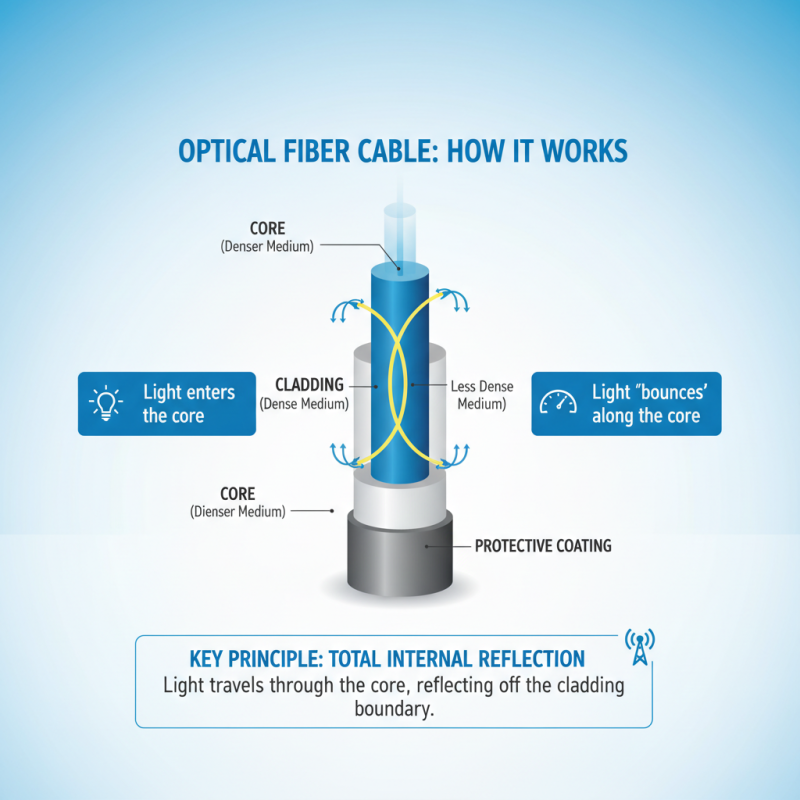
The design of Optical Fiber Cable is fascinating. It consists of a core surrounded by a cladding, both made from glass or plastic. Light travels through the core, reflecting off the cladding. This creates a clear pathway for data. However, not everyone understands its potential. Many still rely on outdated technologies. This reliance raises questions about future innovations in the industry.
Challenges exist in the Optical Fiber Cable sector. Installation can be complex and costly. Moreover, some regions lack access to this advanced technology. These hurdles need addressing to fully harness the benefits of optical fibers. As we move forward, fostering understanding and awareness will be crucial for the development of this essential infrastructure.

What is Optical Fiber Cable?
Optical fiber cable is a technology that uses light to transmit data. This method provides faster and more reliable internet connections compared to traditional copper wires. According to a recent report by the Fiber Broadband Association, the demand for optical fiber networks is growing. By 2025, over 80% of internet connections in urban areas are projected to be fiber-based.
The core of an optical fiber is made of glass or plastic. Light travels through this core in a zig-zag pattern, allowing data to move at incredible speeds. The bandwidth potential for fiber optics is vast. Some systems can support over 100 Gbps. However, the installation and material costs can be higher than conventional cables. Many still hesitate to adopt this technology due to these costs.
Despite the clear advantages, optical fibers have their challenges. They are more fragile and can be damaged if not handled carefully. Also, connecting fiber cables requires specialized tools and expertise. This makes maintenance tricky. As technology evolves, addressing these issues will be essential for wider adoption. In conclusion, understanding optical fiber cables is vital for future communication advancements.
What is Optical Fiber Cable and How Does it Work?
| Dimension |
Description |
| Core |
The central part of the optical fiber where light travels. |
| Cladding |
The layer surrounding the core that reflects light back into the core. |
| Buffer Coating |
Protects the fiber from damage and environmental factors. |
| Strengthening Fiber |
Provides additional strength to the cable structure. |
| Outer Jacket |
The external protective layer that shields the fiber from physical damage. |
| Transmission Speed |
Optical fibers can transmit data at speeds up to several terabits per second. |
| Distance |
Can transmit data over long distances, often exceeding 100 kilometers without repeating. |
| Types of Fiber |
Single-mode and Multi-mode fibers serve different applications. |
| Applications |
Used in telecommunications, internet services, and cable television. |
The Structure of Optical Fiber: Core, Cladding, and Jacket
Optical fiber cables are fascinating. They use light to transmit data. Understanding their structure is key to grasping how they work. The main parts are the core, cladding, and jacket.
The core is the heart of the fiber. It carries the light signals. It’s made of glass or plastic. The core’s diameter can be very small, often just a few microns. Surrounding the core is the cladding. This layer reflects light back into the core. It helps maintain signal strength over long distances. The cladding is essential for reducing signal loss.
The outer jacket protects the optical fiber. It shields it from damage and external elements. The jacket can be made of various materials like plastic or rubber. This protective layer ensures durability.
Tip: Always handle optical fibers with care. They can be fragile. Avoid bending them sharply to prevent breaks.
Understanding these parts helps in many areas, like telecommunications. Many people overlook the importance of the cladding. It plays a crucial role in performance. When thinking about fiber installation, consider the environment too.
Tip: Choose a jacket material suitable for your environment. Indoor and outdoor cables differ significantly. This choice can impact longevity and performance.
Optical Fiber Cable: Transmission Speed Comparison
How Optical Fiber Works: Total Internal Reflection Explained
Optical fiber cable is a remarkable technology used for transmitting data. It works primarily through a principle called total internal reflection. This phenomenon occurs when light travels from a denser medium to a less dense one, at an angle greater than the critical angle. Inside the fiber, light signals bounce back and forth, making their way quickly along the length of the fiber.
Most optical fibers consist of a core, made of glass or plastic, surrounded by a cladding layer. The core has a higher refractive index than the cladding. This design ensures that light signals remain trapped within the core, allowing minimal loss of signal quality. A recent industry report indicates that the global market for optical fibers is expected to reach $6 billion by 2026, driven by increasing demand for high-speed internet.
Tips: When handling optical fibers, ensure they are clean. Dust can impair signal quality. Also, remember that optical fibers are fragile. Take care during installation to avoid breakage. Use appropriate tools for cutting and splicing.
While optical fibers offer high-speed transmission, they can be sensitive to environmental conditions. Changes in temperature or bending can affect performance. It's crucial to monitor and manage these factors in installation and maintenance. Continuous research will enhance the technology, addressing existing limitations and challenges.
Types of Optical Fiber: Single-mode vs. Multi-mode Cable
Optical fiber cables come in two main types: single-mode and multi-mode. Each has unique properties that suit different applications. According to industry reports, single-mode fiber is designed for long-distance data transmission. It uses a single light path, reducing signal loss. This cable type can span several kilometers, making it ideal for telecommunication networks and large-scale data centers.
Multi-mode fiber, on the other hand, supports multiple light paths. It is typically cheaper and easier to work with for shorter distances. However, it experiences higher signal loss than single-mode fiber. Many organizations use multi-mode in campus environments or internal networks, where the distance is often less than 2 kilometers. Data from the Fiber Optic Association shows that over 70% of fiber installations opt for multi-mode due to its lower cost and ease of use.
While both types have their advantages, decisions should consider the specific needs of a project. Some may prioritize cost over distance, leading to challenges as bandwidth demands grow. Each choice reflects a balance of performance versus budget constraints. This ongoing dilemma is a part of the evolving landscape of fiber optics.
Applications of Optical Fiber in Telecommunications and Beyond
Optical fiber cables play a crucial role in modern telecommunications. They transmit data as light pulses, providing high speed and large bandwidth. This technology has transformed how we connect with each other and access information. Beyond telecommunications, optical fibers are finding applications in various fields, including medical devices and industrial networking.
In healthcare, optical fibers are essential in minimally invasive surgeries. They enable doctors to see inside the body with precision. Surgical instruments often use fiber optics for illumination and imaging. This technology reduces recovery time and enhances patient comfort. However, the complexity of these systems can lead to unforeseen challenges.
Tip: Consider the future. As technology advances, new uses for optical fibers may arise. Stay updated on trends to leverage these innovations.
Additionally, in manufacturing, optical fibers enhance sensor capabilities. They monitor parameters like temperature and pressure in real-time. This offers businesses timely data for decision-making. Nonetheless, the cost of implementing fiber optic systems can be a barrier for some companies.
Tip: Evaluate your needs. Invest in fiber optics only if it adds significant value to your operations.